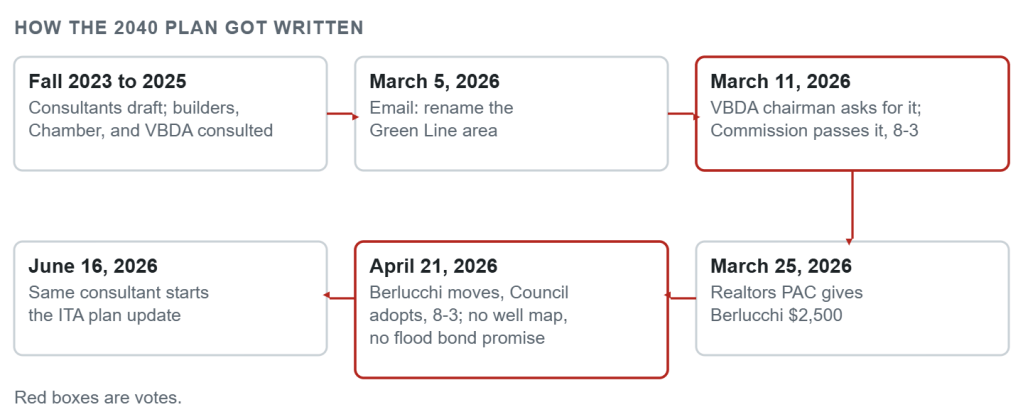
On April 21, 2026, City Council adopted imagineVB 2040, the Comprehensive Plan that will guide what gets built in Virginia Beach for the next 15 years, 8-3.1 The ordinance swears the plan was written to “best promote the health, safety, morals, order, convenience, prosperity and general welfare” of the City and its citizens, and that it complies with every required section of the Code of Virginia.2
So the plan was written for the residents, right? The studies the law requires . . . they were done . . . right? The residents who drink from private wells . . . somebody mapped where they are . . . right?
Nope. The builders’ and Realtors’ money went to the members who voted for it. The developers’ attorney who chairs the VBDA had the plan’s words changed at the last minute “to preserve that flexibility.” And the plan does not map a single private well, even though the Navy has found “forever chemicals” in Virginia Beach drinking water wells since 2016.
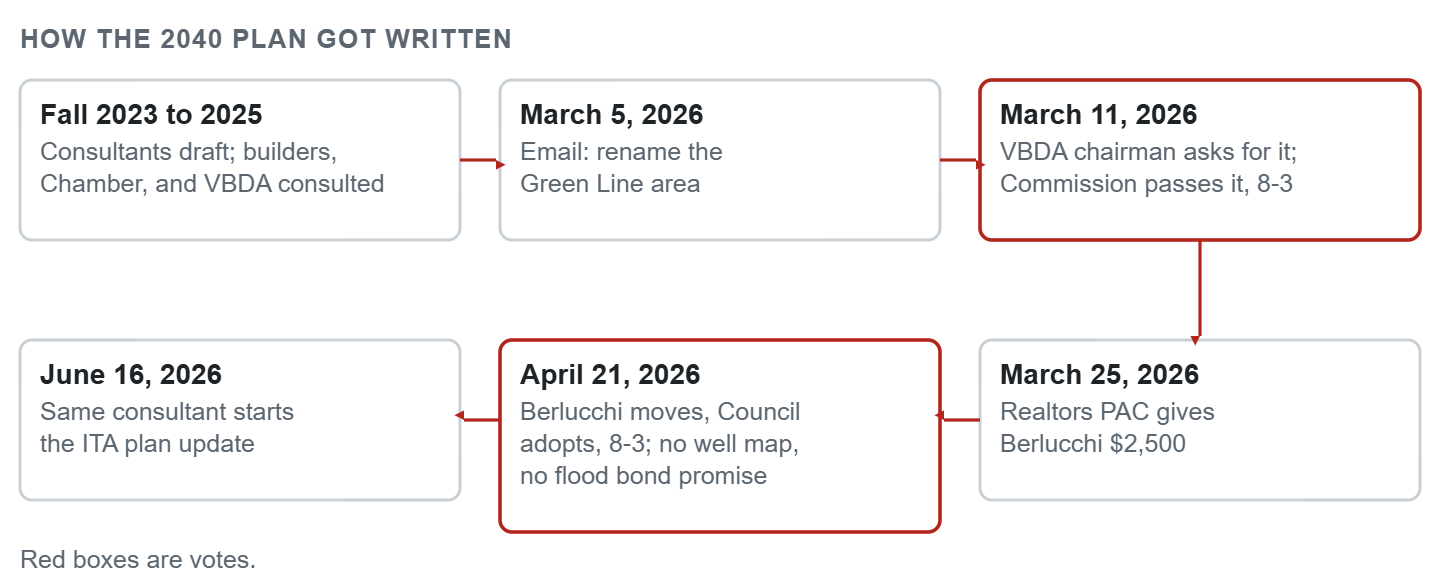
The biggest conflict:
Lisa Murphy, a partner at Willcox & Savage who represents developers in front of the Planning Commission and City Council, sitting as chairman of the VBDA, asking the Planning Commission to rename the Green Line area “to preserve that flexibility,” and getting it, with no notice to the public, on the night the Commission voted.3
Bought: The money behind the ‘ayes’
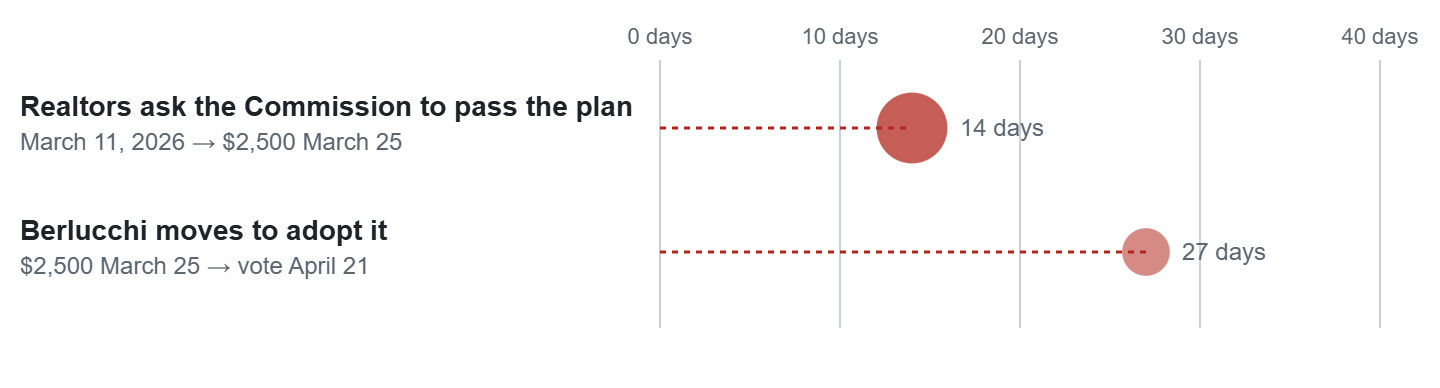
Funding seven of the eight ‘ayes’ before the vote, the builders’ association and the Realtors gave $43,250.4 The Realtors’ statewide PAC sent Berlucchi $2,500 on March 25, 2026, two weeks after the Realtors’ president asked the Planning Commission to pass the plan, and 27 days before Berlucchi made the motion to adopt it.5,6
- Rosemary Wilson: $13,750. Builders $8,750, Realtors $5,000. Wilson seconded the motion to adopt.4,1
- Michael Berlucchi: $11,000. Builders $3,000, Realtors $8,000, including $2,500 on March 25, 2026. Berlucchi made the motion to adopt.4,5
- Bobby Dyer: $9,000. Builders $8,000, Realtors $1,000.4
- Amelia Ross-Hammond: $5,500. Builders $4,000, Realtors $1,500.4
- Joash Schulman: $2,000. Builders $1,000, Realtors $1,000.4
- Stacy Cummings: $1,000. Builders.4
- David Hutcheson: $1,000. Builders.4
Drafted: Who held the pen
The consultants. The plan names its “Consultant Team”: Renaissance Planning (Chris Sinclair and Kohl Malo) and Dills Architects (Gerrie West and Clay Dills).7 Dills Architects was, simultaneously, the architect on Hampton Roads Transit’s request for a VBDA deal at Corporate Landing,8 the City’s planner for the Central Beach Small Area Plan, briefed with Economic Development,9 and, two months after adoption, the firm presenting the update of the Interfacility Traffic Area (ITA) master plan, the plan for the land around Oceana and Fentress.10 The public paid for the work: on March 7, 2023, Council moved $300,000 of General Fund vacancy savings to the Planning Department “to fund the work associated with the update,” by consent, 10-0, on a motion by Schulman, seconded by Ross-Hammond.11 Eleven weeks later, staff told Council it had “Finalized contract with consultants,” Renaissance Planning and Dills Architects.12 What each firm was paid in total is not in the minutes.
The capacity numbers no one was shown. The plan forecasts about 24,000 more residents by 2040.13 At the Planning Commission’s final hearing, Commissioner Bryan Plumlee said the plan builds in room for about 79,000 future residents, while “The University of Virginia is telling us we’re looking at about 20,000 residents,” and that the consultant’s breakdown of where they would go had never been given to the Commission: “has that document been circulated to everyone?” Planning staff: “No, sir, it has not.”14
The stakeholders. Among the outside groups the plan thanks: the Coastal Virginia Building Industry Association, the Hampton Roads Chamber, Virginia Beach Vision, and the VBDA.7
The last-minute rewrite. The final draft the public reviewed called the land between the Green Line and the rural area the “Green Line Context Area.”15 Then, on March 5, 2026, six days before the hearing, the Planning Director emailed commissioners that Council wanted it renamed the “Courthouse Context Area,” and the Blue Line renamed the “Rural Area Boundary.” No such request appears in Council’s minutes.16 At the hearing, Murphy, “the chair of the Virginia Beach Development Authority,” asked for exactly that:
“changing the phraseology back to what it was helps to preserve that flexibility, and certainly the public perception as far as what should happen in those areas.”3
She also told the Commission that “the next step in the process, once the comprehensive plan is adopted, is to bring together all the stakeholders and businesses with staff to update the ITA-TIA Plan.”3 Commissioner Walter Camp: “a last-minute maneuver, depriving the public of comment.” Commissioner Michael Mauch: “I just heard about it today for the first time.”17 Camp’s motion to pass the plan without the renaming failed 5-6. The renamed plan then passed 8-3. Plumlee, Dragas’s attorney in Chesapeake, voted ‘aye’ and made the motion certifying it to Council.18,19 Commissioner Holly Cuellar, an employee of Bob McDonnell’s firm, said she had been “discussing this issue at length for about a year.”16 Council adopted the plan with the new name.7
Before this plan. Council adopted the 2016 plan by consent on May 17, 2016, on a motion by Louis Jones, seconded by Jim Wood; John Moss voted ‘nay.’20 When Council later tried to add a stormwater rule to the 2016 plan, the builders’ lobbyists spoke against it and Council shelved it, 6-5. That story is in Flood Bonding Out Developers and Developers Dictate the Building Regulations.21
Broken: Where the plan breaks the law
The ordinance says the plan complies with Va. Code §§ 15.2-2223 through 15.2-2224.2 We read the plan, appendices included, against those sections and the Chesapeake Bay rules. This is what is missing.
1. The wells nobody mapped
The 2016 plan counted “more than 20,000 private wells operating in the northern portion of the City,” as of 2008, and said “It is imperative that an action plan be established to monitor all activities that may contribute to the degradation and depletion of the city’s aquifers.”22 Ten years later, there is no action plan. The new plan drops the well count entirely. It says “Residents in the Rural Context Area rely solely on groundwater,” then never maps a single well, rural or northern.23
Its list of what pollutes groundwater names croplands, lawns, livestock, failing septic systems, storage tanks, and construction.23 It leaves out industry, landfills, and the military. It never mentions PFAS.24
Meanwhile, the Navy says firefighting foam put PFAS in the groundwater at NAS Oceana, and it has “been detected in nearby drinking water wells that are located in the direction that the groundwater flows away from NAS Oceana.” One Virginia Beach well tested at 130 parts per trillion of PFOA and PFOS combined; the federal action level is 12 for each. That home was hooked up to City water.25 The plan rings Oceana with three Special Economic Growth Areas, East, West, and South Oceana, that “can accommodate future industrial and logistics businesses,” and says “Their designation primarily considers proximity to NAS Oceana.” West Oceana already holds the Oceana West Industrial Park. Elsewhere the plan calls for “large-scale industrial, manufacturing, warehousing, and logistics buildings (i.e., Corporate Landing Business Park),” the VBDA’s park.26 Not one map shows where the drinking water wells sit downstream of any of it.
State law: Va. Code § 15.2-2224(A)(1)
In preparing the plan, the Planning Commission “shall survey and study” the “groundwater and surface water availability, quality, and sustainability.”27 The plan’s only groundwater figures are a paragraph of general description. No survey of private wells, their water quality, or their sources appears in it.23
State law: Chesapeake Bay Act, Va. Code § 62.1-44.15:74(B), and 9VAC25-830-170
Tidewater localities “shall incorporate protection of the quality of state waters” into the comprehensive plan.28 The state’s rule spells out what that means: a “Catalog of existing and potential water pollution sources,” “A map or map series accurately representing the above information,” and a policy on “Protection of potable water supply, including groundwater resources and threats to the water supply or groundwater resources from existing and potential pollution sources,” with “a description of how the local policy will be implemented.”29 The plan has no catalog, no map, and no potable water policy. Its only well policy is extending City water “where septic tanks and wells have exceeded their life cycle and are failing,” and its education program is about “non-potable groundwater.”30
Federal law. On April 26, 2024, the U.S. Environmental Protection Agency set the first federal drinking water limits for PFAS under the Safe Drinking Water Act, and the Navy’s cleanup at Oceana runs under the federal Superfund law (CERCLA).25 Both were in place two years before Council adopted a plan that does not mention either.
2. The studies nobody did
What the ordinance offers as the “surveys and studies” were opinion surveys and meetings: “three surveys, hosted ten focus group meetings and twelve public meetings, and staff attended over 100 stakeholder meetings.”2
- Soils from 1985: The plan rests its rural density limits and septic rules on “the 1985 issue of the Virginia Beach Soil Survey,” and the soil map itself “is available from the Planning Department,” not in the plan.31
- Growth without the math: Room for 79,000 new residents against a forecast of about 24,000, with the consultant’s breakdown never given to the Commission.14,13
- Transportation, “the bare requirement”: Camp said the Master Transportation Plan update “meets the bare requirement that state law and VDOT has imposed on it,” after “a decision was made administratively to not proceed with certain changes.” Staff agreed.32
- The technical appendices that never came: The 2023 schedule promised a “Phase 4: Technical Appendices.”12 The adopted plan’s four appendices are a zoning table, maps of the growth centers, a list of documents adopted by reference, and the 1985 soils.33 The 2016 plan came with a separate Technical Report, including the aquifers and a map of major groundwater withdrawals.34
State law: Va. Code §§ 15.2-2223(A) and 15.2-2224(A)
The Planning Commission “shall make careful and comprehensive surveys and studies of the existing conditions and trends of growth, and of the probable future requirements of its territory and inhabitants” (§ 15.2-2223(A)), including land use, natural resources, groundwater, drainage, flood control, and “Probable future economic and population growth of the territory and requirements therefor” (§ 15.2-2224(A)).35,27 Counting meetings is not a study of groundwater, soils, or drainage, and a 41-year-old soil survey is not a study of existing conditions. The ordinance’s claim that the plan complies with § 15.2-2224 is false: we looked in the plan, its appendices, and the adoption record, and the required groundwater and pollution-source studies are not there.2
3. Not drafted for the residents’ health, safety, and welfare
- The flood bond promise, gone: To win the 2021 flood bond, Council promised to recommend denial of any project that adds stormwater.36 The new plan does not contain it.1
- Drinking water, ignored: Residents who “rely solely on groundwater” get no map, no source protection, and no word about the PFAS the Navy found.23,25
- “Flexibility” for the ITA: The VBDA chairman’s rename, made “to preserve that flexibility,” went in with no public notice, and the same consultant is now rewriting the ITA plan with “the stakeholders and businesses.”3,10
- Words that bind no one: In the Southern Rivers Watershed, the plan will “Continue recommending” an engineer’s review of development.30
State law: Va. Code §§ 15.2-2223(A) and 15.2-2200
The plan “shall be made with the purpose of guiding and accomplishing a coordinated, adjusted and harmonious development of the territory which will, in accordance with present and probable future needs and resources, best promote the health, safety, morals, order, convenience, prosperity and general welfare of the inhabitants.”35 The chapter exists so “that residential areas be provided with healthy surroundings for family life.”37 A plan that never asks where its residents get their drinking water, and drops the flood promise made to win their votes, does not meet that purpose.
City: Council’s own flood bond commitments
On September 7, 2021, Council voted 10-0 to commit to recommending denial of projects that cause a net increase in stormwater.36 On April 21, 2026, eight members adopted a Comprehensive Plan without it.1
The money, by member
Builder and Realtor gifts to the members who voted ‘nay’ before April 21, 2026: Jackson-Green $2,000 and Henley $1,000. Rouse received none.4
Notes and sources:
- City Council minutes, April 21, 2026, Item 78250 (Ordinance to adopt the Virginia Beach Comprehensive Plan, imagineVB 2040), PDF pages 199–200. Berlucchi moved and Wilson seconded. ‘Aye’: Michael Berlucchi, Stacy Cummings, Bobby Dyer, David Hutcheson, Worth Remick, Amelia Ross-Hammond, Joash Schulman, and Rosemary Wilson. ‘Nay’: Barbara Henley, Cash Jackson-Green, and Jennifer Rouse. Henley’s motion to defer it 60 days failed 3-8. ↩
- City Council minutes, April 21, 2026, Item 78250, ordinance CA17088, PDF page 201. ↩
- Planning Commission minutes, March 11, 2026, Items 1 and 2 (imagineVB 2040 Comprehensive Plan ordinance and resolution), PDF pages 16–17. ↩
- Virginia Department of Elections campaign finance reports and the Virginia Public Access Project, as logged in the KVBAW Org-Groups Log, Money tab, November 20, 2026. Builders: Political Action Committee of Tidewater Builders Association, the PAC of the Coastal Virginia Building Industry Association (CVBIA). Realtors: Coastal Virginia Association of Realtors and Realtors Political Action Committee of Virginia. Only gifts dated before April 21, 2026 are counted. Remick’s builder and Realtor gifts (September 3 and August 26, 2026) came after the vote. ↩
- Realtors Political Action Committee of Virginia to Friends of Michael F. Berlucchi, $2,500, March 25, 2026, Virginia Department of Elections report 494933 (committee CC-24-00070). ↩
- Planning Commission minutes, March 11, 2026, Items 1 and 2, PDF pages 13–16 (Phil Kazmirczak, president of the Hampton Roads Realtors Association: “we see a great deal of alignment between its goals and the policy positions that the Hampton Roads Realtors Association has adopted”). ↩
- imagineVB 2040, City of Virginia Beach Comprehensive Plan, adopted April 21, 2026, Acknowledgments, pages 3–4; also City Council minutes, April 21, 2026, Item 78250, PDF page 205. ↩
- City Council minutes, August 12, 2025, Item 77370 (Hampton Roads Transit land request briefing), PDF page 5 (“Disclosures”: “Architect — Dills Architects, Clay Dills”). ↩
- City Council minutes, April 1, 2025, Item 76832 (Central Beach Small Area Plan Update briefing by Clay Dills, Owner, Dills Architects), PDF pages 2 and 81 (“Comprehensive Plan Tie-In”). ↩
- City Council minutes, June 16, 2026, Item 78434 (Interfacility Traffic Area and Vicinity Master Plan Update briefing, Kathy Warren, Director, Planning, and Clay Dills, Owner, Dills Architects), PDF page 26. ↩
- City Council minutes, March 7, 2023, Item 73898, PDF pages 83–84 (ordinance CA16092). ↩
- City Council minutes, May 23, 2023, Item 74264 (Comprehensive Plan Update briefing), PDF pages 19–22. ↩
- imagineVB 2040, Chapter 1, Table 1-1 (459,470 in 2020; forecast 483,916 in 2040), page 12. ↩
- Planning Commission minutes, March 11, 2026, Items 1 and 2, PDF pages 10–11. Plumlee received the breakdown from “Chris from Renaissance.” ↩
- City Council minutes, February 24, 2026, Item 78041 (imagineVB 2040 briefing), PDF pages 56, 62, and 73–74 (“Why is it being updated?” and “Chapter 5: Green Line Context Area”). ↩
- Planning Commission minutes, March 11, 2026, Items 1 and 2, PDF pages 18 and 23 (Coston: “Actually, the fifth, yes.”). We looked in the City Council minutes for February 24, March 3, March 10, and March 12, 2026. ↩
- Planning Commission minutes, March 11, 2026, Items 1 and 2, PDF pages 21–22. ↩
- Planning Commission minutes, March 11, 2026, Items 1 and 2, PDF pages 25–27. Substitute motion 5-6: ‘aye’ Camp, Cromwell, Anderson, Byler, and Mauch; ‘nay’ Schoonover, Plumlee, Hippen, Cuellar, Coston, and Moorjani. Plan 8-3: ‘nay’ Camp, Cromwell, and Mauch. ↩
- Plumlee represented Dragas Associates before Chesapeake City Council on July 16, 2024 and December 17, 2024; The Virginian-Pilot, July 17, 2024, called him the applicant’s attorney. ↩
- City Council minutes, May 17, 2016, Ordinance to adopt the Comprehensive Plan, It’s Our Future: A Choice City, 2016, PDF pages 40, 117, and 129–130. ↩
- City Council minutes, May 3, 2022, Item 72818, PDF pages 159–160. ↩
- Comprehensive Plan, It’s Our Future: A Choice City, 2016, Policy Document, Groundwater, as attached to City Council minutes, May 17, 2016, PDF page 364. ↩
- imagineVB 2040, Chapter 2, Water, page 52. ↩
- imagineVB 2040, full text searched for “PFAS,” “contamination,” “landfill,” “industrial” (in the groundwater section), and “wellhead,” November 21, 2026. ↩
- U.S. Navy, Naval Facilities Engineering Systems Command, “Oceana PFAS Drinking Water Well Sampling” (results as of October 2025), Tables 2 and 3, read November 21, 2026: 15 private wells sampled 2016 to 2024, two at or above the Department of Defense interim action levels, one above 70 parts per trillion; 17 sampled in 2025. Release areas on base include the Fire Training Area, the Fuel Tank Farm, and four landfills. https://www.navfac.navy.mil/Divisions/Environmental/Products-and-Services/Environmental-Restoration/Mid-Atlantic/Oceana-NAS/Oceana-PFAS-Sampling/. ↩
- imagineVB 2040, Chapter 3, Special Economic Growth Areas, page 90 (“SEGAs do not have formal plans.”); Chapter 7, Industrial and Logistics place type, page 162. ↩
- Va. Code § 15.2-2224(A)(1), law.lis.virginia.gov. ↩
- Va. Code § 62.1-44.15:74(B), law.lis.virginia.gov. ↩
- 9VAC25-830-170(1)(f) and (h), (2)(b)(2), and (2)(c), law.lis.virginia.gov. ↩
- imagineVB 2040, Chapter 2, Water Quality and Flood Protection policies, page 61. ↩
- imagineVB 2040, Appendix D, Soils Information, pages 266–267. ↩
- Planning Commission minutes, March 11, 2026, Items 1 and 2, PDF page 12. ↩
- imagineVB 2040, Contents, page 2 (Appendix A: Zoning to Place Types; Appendix B: Center Area Map Series; Appendix C: Documents Adopted by Reference; Appendix D: Soils Information). ↩
- Comprehensive Plan, It’s Our Future: A Choice City, 2016, Technical Report, Groundwater, as attached to City Council minutes, May 17, 2016, PDF pages 550–551. ↩
- Va. Code § 15.2-2223(A), law.lis.virginia.gov. ↩
- City Council minutes, September 7, 2021, Item 71975 (resolution of commitments for the flood protection referendum), commitment 3. ↩
- Va. Code § 15.2-2200, law.lis.virginia.gov. ↩
Last updated November 21, 2026.
Have records or evidence about this? Email keepvbabovewater@gmail.com.


Leave a Reply